Cloud analytics and remote monitoring only make sense when plant data leaves the floor in a reliable, structured form. That is where MQTT and the Sparkplug B specification built on top of it come in.
What Is MQTT?
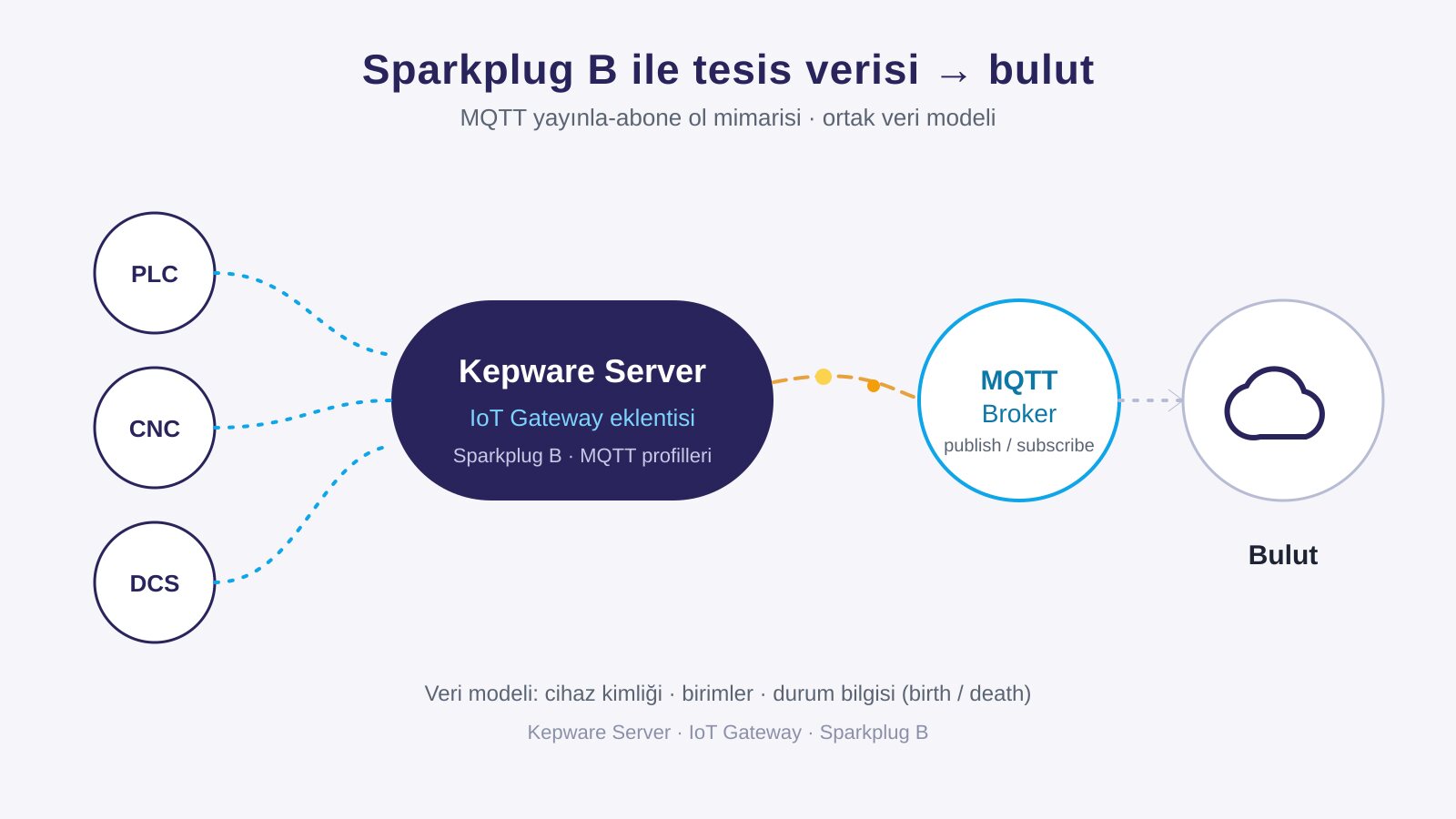
MQTT is a lightweight publish-subscribe protocol. Devices publish messages to topics on a broker; subscribers listen to those topics and receive the data. This model is far more flexible than client-server: the data producer does not need to know who is listening.
Why Sparkplug B?
MQTT alone does not define a data model. If device A publishes a value as \"temperature\" and device B uses a different structure, the receiver has to write custom parsing code per device. Sparkplug B defines a common data model and recommended topic structure for industrial data over MQTT: device identity, measurement units, state information and birth/death semantics become standard.
Verify the data format on the Kepware side
Kepware IoT Gateway publishes tag values, quality and timestamps as JSON over MQTT or REST. MQTT support alone does not establish Sparkplug compatibility. For projects requiring Sparkplug, verify the topic structure, payload format and state messages for the selected plug-in and version; plan a suitable conversion layer when needed. Official Kepware IoT Gateway documentation.
Typical Use Cases
- Remote plant and field monitoring dashboards,
- Continuous time-series streams into cloud data warehouses,
- Vendor-neutral IIoT scenarios (interoperability with Sparkplug-compliant clients),
- Asset management and predictive maintenance projects.
If you are planning an MQTT and Sparkplug B data flow, talk to us.